Dulin, Thomas Jacob
August 4, 1834 - April 8, 1918
Early Baptist pastor; community figure; medical doctor
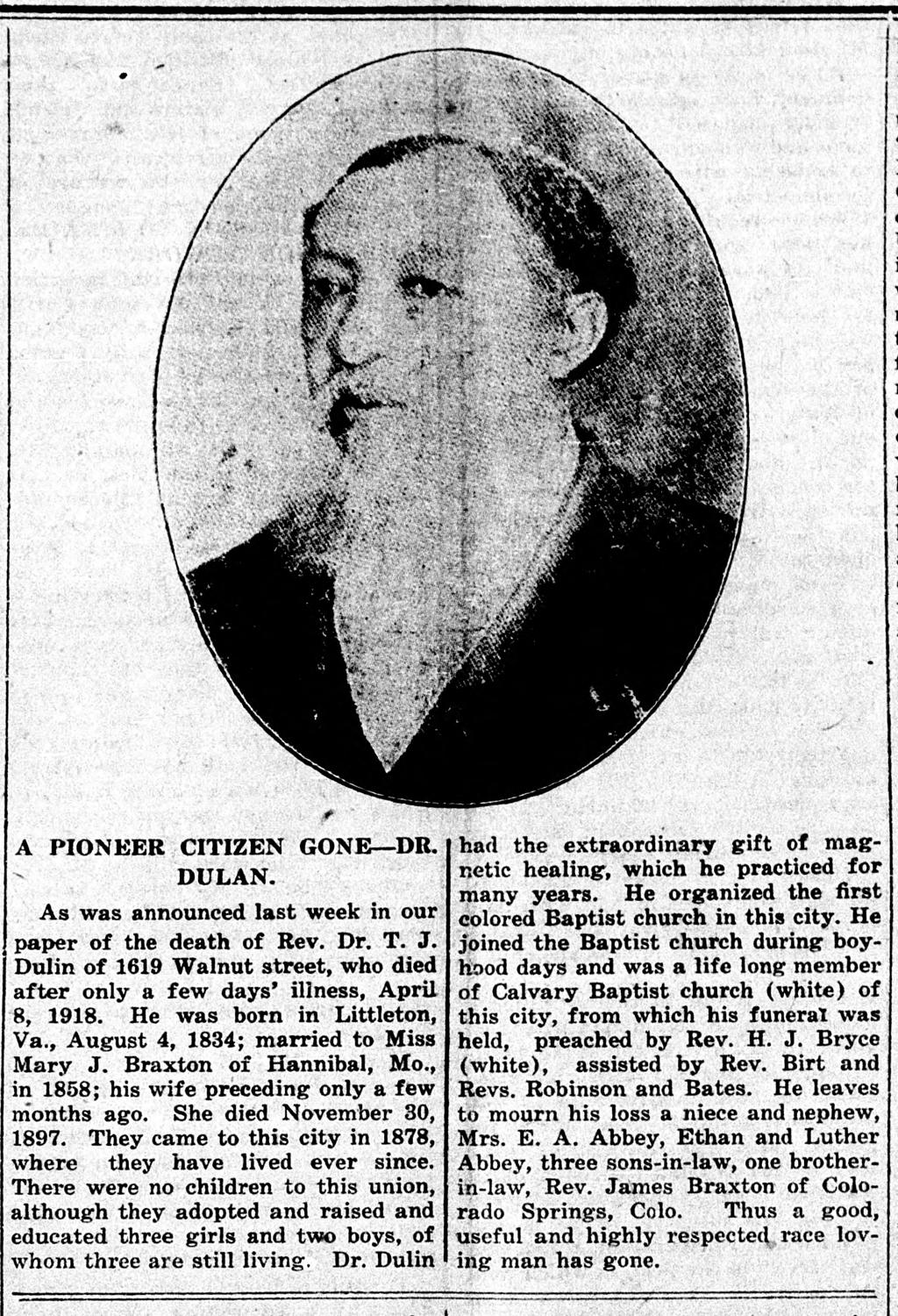
Rev. Dr. Thomas Jacob Dulin, was a longtime Des Moines resident who rose to prominence as a Baptist minister in the mid-1880s. He generally was known by his middle name. A native of Virginia, sources vary on his birth year but his grave marker reads August 4, 1834.
“Rev. J. Dulin” appeared in Des Moines newspapers by 1885 as pastor for the Olive Baptist Church of East Des Moines. He had been in Linn County, Missouri as recently as the 1880 federal population census. The Iowa State Bystander had multiple notes in 1897 regarding Dr. J. Dulin. In September it was noted he would be at Tabernacle (Corinthian) Baptist Church at 11th and Crocker. An October note mentioned he planned to preach at the AME church. Earlier in the year it was noted he was hosting Rev. W. N. Stewart of Keokuk, and presumed that it was at the East Side Baptist Church. This church may have had white and Black members.
A May 24,1907 profile in the Iowa State Bystander noted “perhaps no Negro in the city of Des Moines has a more unique history.” It reported that Rev. Dulin was the former pastor of “East Side Baptist Church,” but he ceased serving as a full time minister due to his medical work. It was also reported that his clients were mainly white people. His residence and office were noted as being at 1619 E. Walnut St.
Dulin remained active in the community. The November 1, 1912, Des Moines Register carried an advertisement in support of William Howard Taft that listed Black supporters including a typographical error of “J. J. Dulin”. He was a frequent minister at services and funerals at Baptist and Methodist churches of Des Moines.
The Iowa State Bystander and Des Moines Tribune both spelled his last name as “Dulan” in death notices and funeral announcements. The Iowa State Bystander carried a front page story with a photographic portrait on April 19, 1918. The story was titled “A Pioneer Citizen Gone.” It noted he established a Baptist Church in Des Moines. His services were celebrated by Black and white ministers, and it was noted that he was a member of Calvary Baptist, a predominantly white church. He is buried in Glendale Cemetery, Des Moines, Iowa